Joe Ansah, founder of Emerald EI Academy, took four businesses to market by directing AI instead of hiring a development team. He has used AI as a daily working tool for about five years and has built ventures full time for the last three.
The four are a voice-first compliance training platform for heavily regulated industries, LAI Workforce Readiness, CINDER (an AI search service for roofing contractors), and a full digital setup for Legacy Mason Contractors, a Latino-owned masonry business.
What they share is a way of thinking. Each one started with a clear picture of the client and the people the client serves. Each one includes a choice most competitors wouldn't make, and something the user doesn't expect. Three of the four launched in about a month each. The compliance platform is the most complex and took about three months.
The ventures show these habits in practice. They are not services LAI sells. LAI trains your staff in the same habits, on the AI your company already uses.
4
markets, from compliance training to masonry, built by one person directing AI
3 of 4
ventures launched in about a month each
#1
unpaid Google map listing for a client within three weeks of launch
2
full languages on the contractor's site, English and Spanish, page for page
The challenge
One person had to build and run products in four different markets. Workforce training, compliance, local search and contracting each have their own buyers, rules and language.
AI tools kept changing the whole time. Anything built around one tool's features would have needed relearning every few months. What stayed the same was how each problem got thought through.
The method
The same four habits show up in every venture below.
1
Find the real problem. Get underneath the request before bringing in AI.
2
Write the work order. Give AI the full picture of the job, so it works from facts instead of guessing.
3
Push past the first answer, and past your own assumptions. Question what AI gives back and what you take for granted before committing.
4
Feed what worked back in. Save what worked so the next project starts ahead instead of from zero.
Venture by Venture
A compliance training platform for regulated industries
Compliance training in heavily regulated industries has worked the same way for years. An employee watches a video, passes a quiz and gets a certificate. That proves attendance, not learning. The U.S. Department of Justice's guide for prosecutors, updated in September 2024, asks how a company measured the effectiveness of its training and whether employees actually learned the material. After misconduct, it asks what the root cause was and what specifically changed. Prosecutors use those answers to decide how a case is resolved, how large the fine is, and whether the company is put under an outside monitor. A company that can only show attendance has a hard time answering, and a single case can cost millions.
So the platform changes what training produces. Instead of proof that someone showed up, it produces evidence of what they understand. Employees talk through real situations with two AI voice coaches, one warm and one direct. Each session records what the employee said, the gap it showed, the regulation involved, the correction and the employee's sign-off. A silent reviewer checks every answer in the background and can only cite regulations from a verified library. It can't make one up. The records can't be changed after the fact.
What users don't expect is that the coaches remember past sessions. Scenarios match the employee's industry, and every session ends with a dated action plan. Buyers also get a toolkit to make the case inside their own company, with an ROI calculator, a regulatory map and a procurement brief.
The platform's content is currently being reviewed by an independent compliance attorney.
About three months to build, across several rounds of revisions.
LAI Workforce Readiness
Employers need their people to use AI well, and they need to see it person by person. That goes for current staff and for people coming back into the workforce.
AI tools change every few months, so training on a specific tool goes out of date fast. LAI teaches the thinking instead, and that changes what an upgrade means. When the work is built the LAI way, with the real problem found, a full work order written and the answer tested, a stronger model simply carries it out better. Nobody starts over. Every improvement in the technology makes the work already done more valuable.
That frees the last part of the training for the tools that extend what AI can do. Learners see how APIs and MCP connect AI to calendars, payment systems and other specialized tools, and how webhooks watch for an event and act on it. They learn to direct AI across their whole set of tools instead of relearning everything each time something new comes out.
LAI was built on the compliance platform's engine rather than from scratch.
Learners tour AI City as its newly elected mayor. Each of its 12 buildings is a real piece of AI technology, and the mayor is the human in charge. Anyone who falls short of the standard is taught again in a different way. The final test is a timed case matched to their work or background, worked with a live AI that knows nothing about the course, just like AI at work.
About a month to build.
CINDER
Roofing company owners want local search, AI search, reviews and lead capture handled as one system for one fixed price.
More and more buyers ask AI for a recommendation instead of just searching Google. So CINDER's audit shows a roofer what AI says about them. It runs real buyer questions through AI and shows the answers, including which competitors AI recommends instead. New content goes out only when people are actually asking about a topic. If nobody is asking, it skips the week instead of posting filler.
The site also finds its own clients. Connected to a sales database (Apollo), it finds roofing companies that fit CINDER's ideal client and checks how each one's website shows up in search and how well it performs. Then it emails the owner a link to a presentation of the findings, led by an AI voice named Cindy, that starts with their weakest area. Only after that can the owner book a meeting with Joe. Thirty days later, a follow-up email asks whether their score has improved. CINDER runs the same system on itself and shows its own results.
About a month to build.
Legacy Mason Contractors, a Latino-owned masonry business
Legacy Mason Contractors is based in Norwalk, Connecticut. The founder is a master mason who runs every job himself. The business depends on two kinds of customers, homeowners in the towns it serves and builders who can't find enough masonry subcontractors. Both look for contractors through local search, and more and more through AI answers.
Local rankings slip when the details on a business's website don't match its Google profile, so the site matches that profile exactly. Every service and town page opens with a short answer written so Google's AI Overviews can quote it. The site launched with a sitemap, schema markup, direct submission to the search engines and performance tracking from day one.
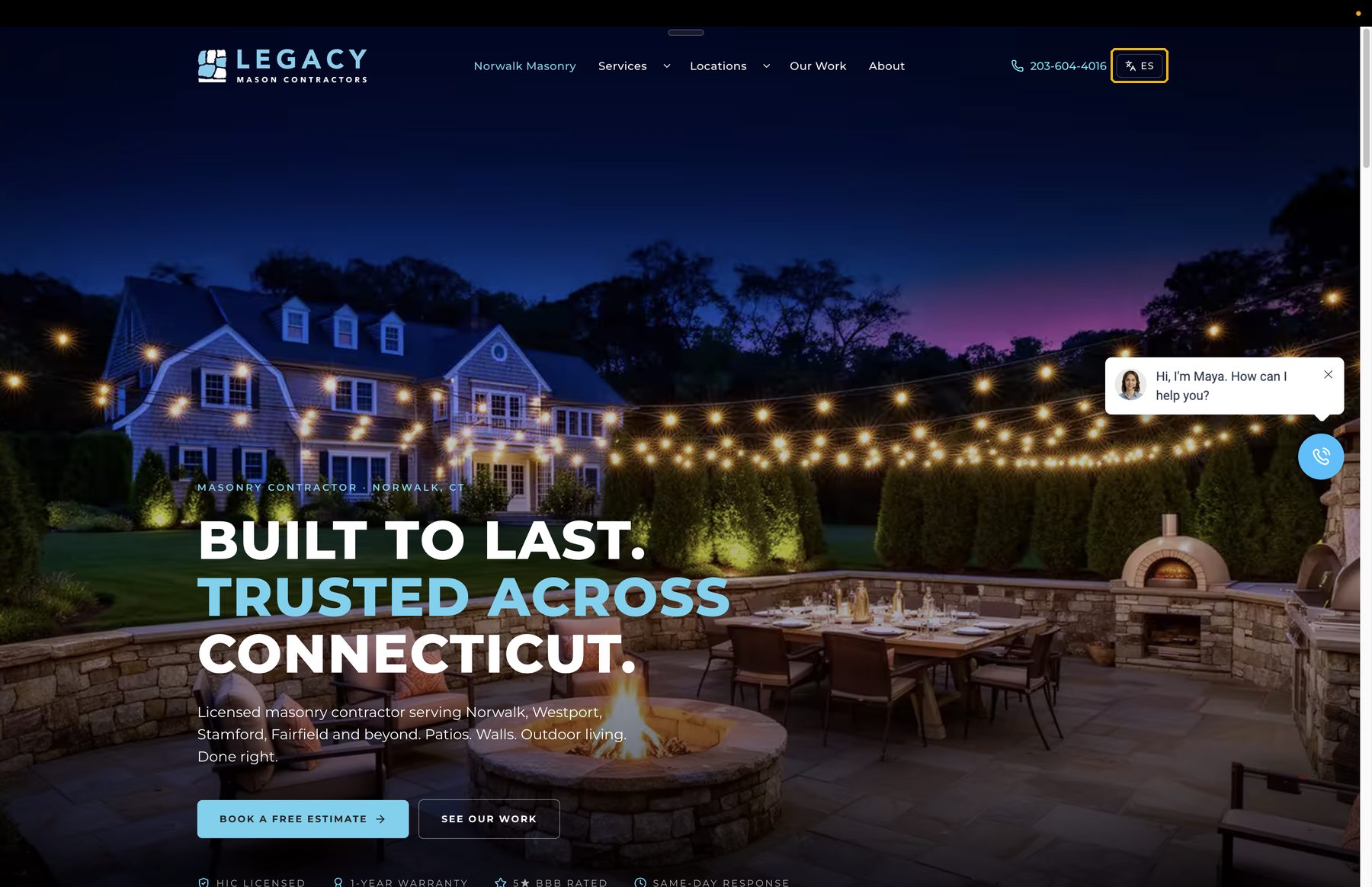
What visitors don't expect is that the whole site is in Spanish too. No visitor should ever feel left out. A Spanish speaker gets the same full site, not a translated homepage with English behind it. An automated check keeps English from slipping into the Spanish pages. An AI review helper turns a customer's quick answers into a draft Google review in their own words, without making anything up. The owner gets a panel that shows how well the site matches the Google profile, and a daily scan flags ranking drops and missed AI mentions. An AI voice assistant answers calls and books appointments.
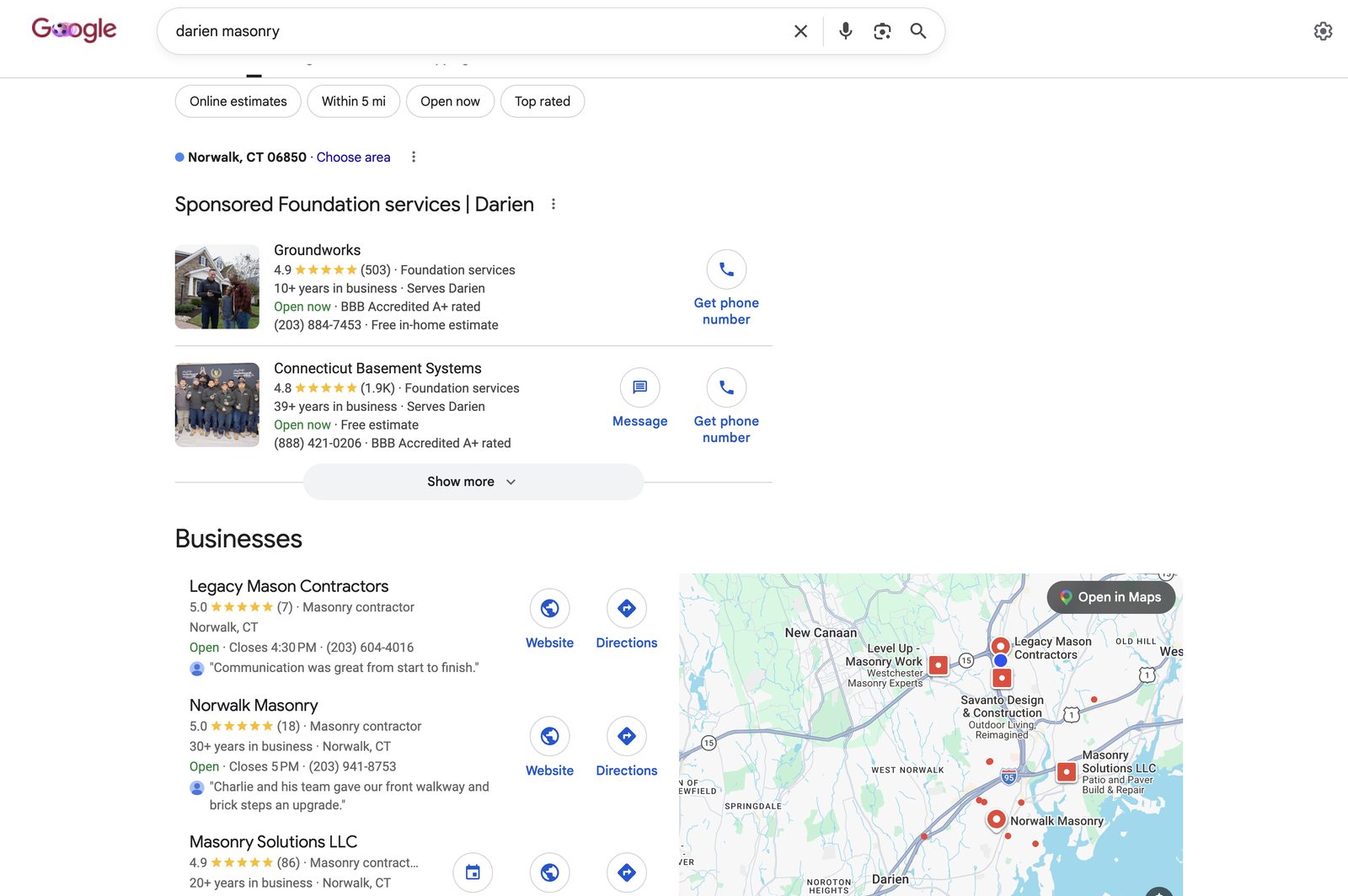
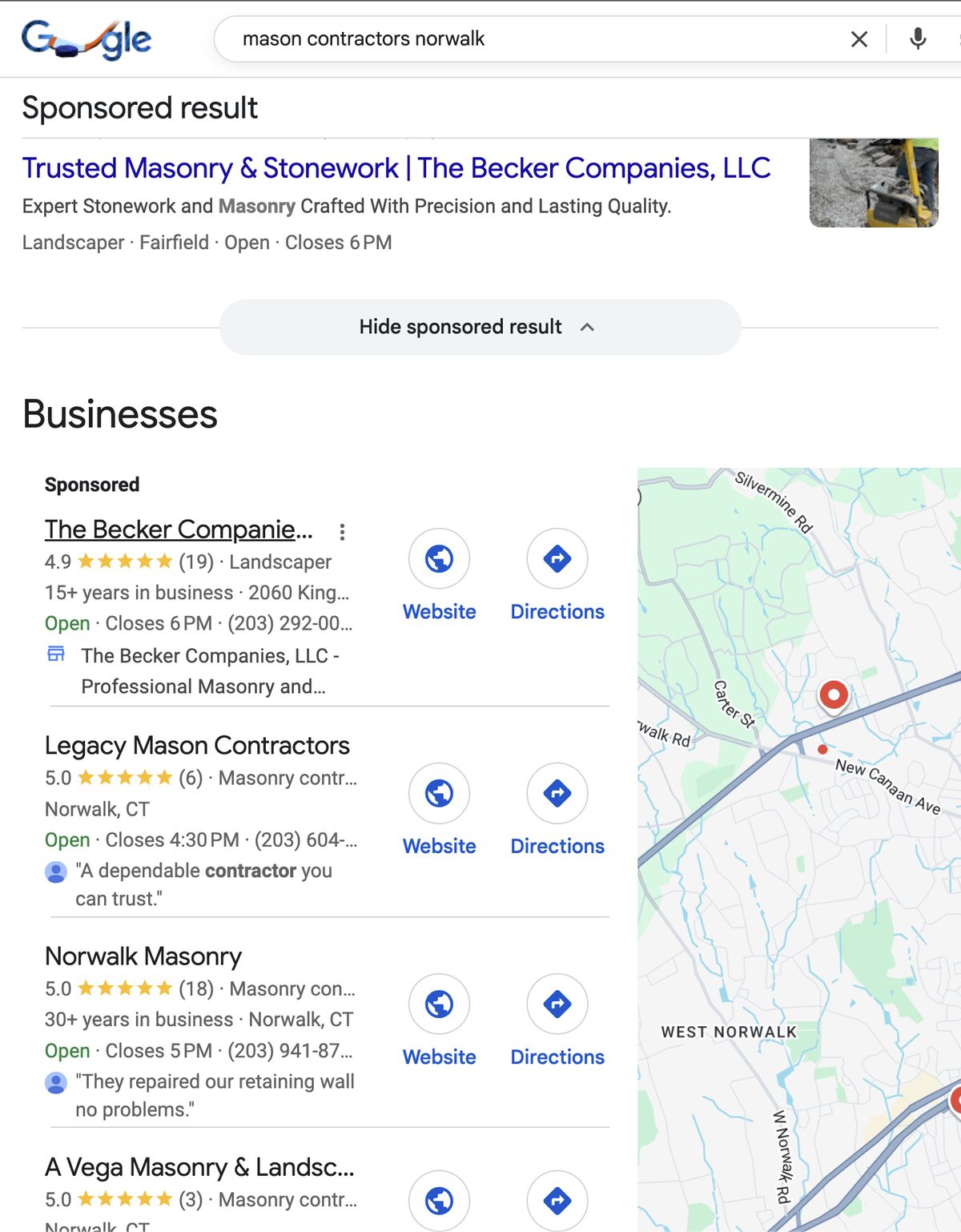
Within three weeks of launch, the business was the #1 unpaid listing in Google's local map pack, the businesses Google shows on the map, for searches like "mason contractors norwalk" and "darien masonry." Rankings change over time. What made this one work was understanding what search engines and AI need before writing anything. The business details matched everywhere, the answers were written to be quoted, and search engines could find and read the site from the first day.
The owner says business is doing great. He gets more calls now from people who are serious about getting work done, and they tell him they called for an estimate because of how professional the website looks.
The live site. The outlined switch at the top right turns every page into Spanish.
Google search for "darien masonry." Legacy Mason Contractors is the first business listed, below the paid ads.Google search for "mason contractors norwalk." Legacy Mason Contractors is the first unpaid listing, below one paid ad.
About a month to build.
What it means for your workforce
Four ventures in four markets show that these habits carry over. The same thinking produced compliance evidence for legal teams, an AI search audit for roofers and a fully bilingual, top-ranked site for a masonry contractor.
That is what employers need as AI takes over routine work. They need people who can move into a new role and still find the real problem, give AI clear direction and check its answer. LAI Workforce Readiness teaches those habits to every employee, one on one, and measures each person's progress.